Sync Mechanisms Aligning Processor Reports With Merchant Ledgers to Stabilize Revenue Tracking for Recurring Global Sales Across Multiple Acquirers
Quinn Schmidt · Aug 18, 2026
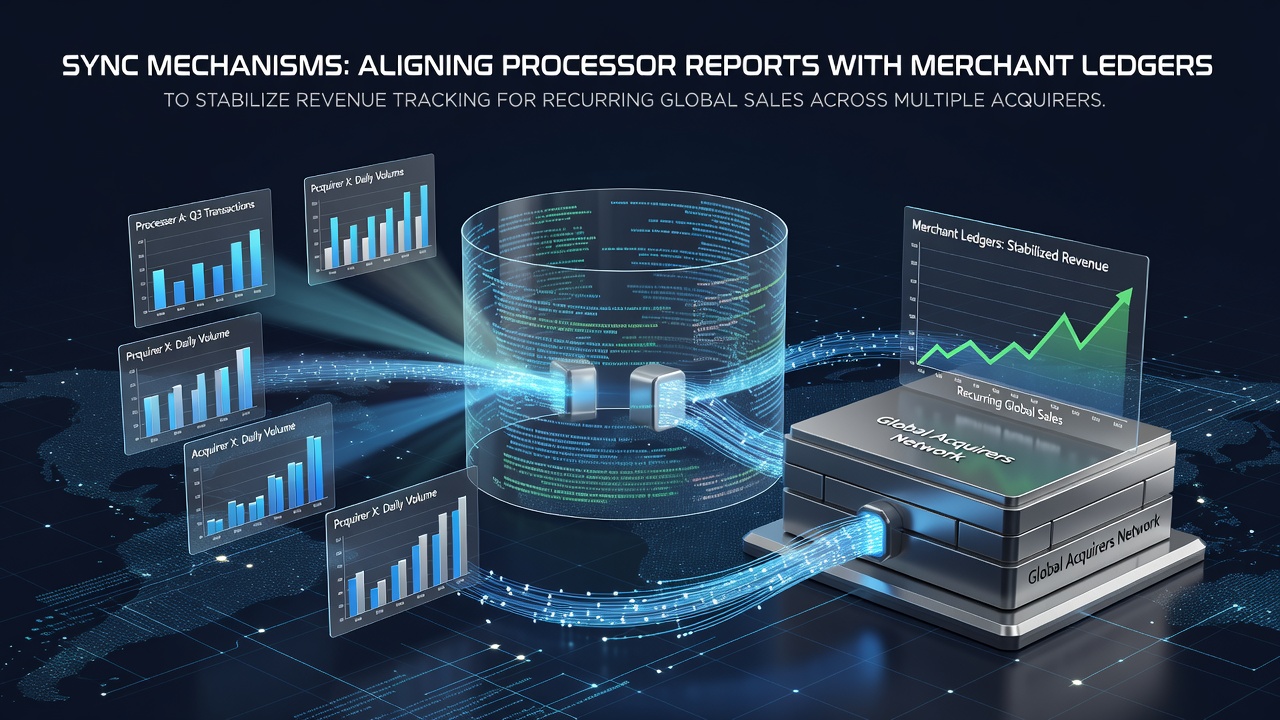
Sync Mechanisms Aligning Processor Reports With Merchant Ledgers to Stabilize Revenue Tracking for Recurring Global Sales Across Multiple Acquirers
Payment processors generate daily reports that detail authorizations, settlements, and fees while merchant ledgers record sales, refunds, and adjustments in their internal accounting systems; synchronization mechanisms reconcile these two data streams so that recurring revenue figures match across multiple acquirers operating in different currencies and regulatory zones. These mechanisms rely on standardized file formats, automated reconciliation engines, and scheduled data pulls that run several times each day, reducing discrepancies that otherwise accumulate when subscription payments cross borders.
Core Components of Alignment Protocols
Processors transmit settlement files that contain transaction identifiers, amounts in both local and reporting currencies, plus fee breakdowns; merchant systems ingest those files through APIs or secure file transfers and map each line item to corresponding ledger entries. Automated rules flag unmatched records for review, while tolerance thresholds allow minor variances caused by foreign-exchange rounding to pass without manual intervention. Researchers at the Bank for International Settlements have documented how these protocols cut reconciliation time from days to hours when implemented across five or more acquirers simultaneously.
Handling Recurring Global Sales Patterns
Subscription platforms process renewals on fixed schedules yet encounter variable approval rates because each acquirer applies its own risk parameters and currency-conversion timing. Sync tools capture both successful charges and failed attempts in processor reports, then compare those outcomes against expected revenue in the merchant ledger so finance teams can adjust cash-flow forecasts before month-end closes. Data from the European Central Bank shows that platforms using real-time ledger matching reduced forecast errors by 18 percent during periods of elevated cross-border volume in 2025.
Multi-Acquirer Reconciliation Challenges
Each acquirer issues reports on its own cadence and in its preferred format, creating gaps when one processor settles in T+1 while another operates on T+2. Alignment systems normalize these timelines by creating a unified transaction journal that timestamps every event to a single reference clock. Observers note that platforms managing recurring sales in more than ten currencies now deploy middleware layers that translate acquirer-specific codes into a common schema before the data reaches the central ledger.

Discrepancies often surface around partial captures, partial refunds, or chargebacks initiated after initial settlement. Sync engines trace each chargeback back to the original authorization record, then post offsetting entries to both the processor file and the merchant ledger so that net revenue calculations remain accurate. Australian regulators at teh Australian Securities and Investments Commission have highlighted similar matching requirements in guidance issued for digital subscription providers operating across the Asia-Pacific region.
Technical Implementation Approaches
Some merchants embed reconciliation logic inside their enterprise resource planning software while others adopt specialized payment-orchestration platforms that sit between acquirers and accounting systems. Both approaches rely on cryptographic checksums to confirm that files have not been altered during transmission. Scheduled jobs run every four hours during peak renewal periods, with exception queues routed to finance teams for same-day resolution. Studies released by the Federal Reserve Bank of New York indicate that organizations running continuous rather than batch reconciliation experience 30 percent fewer end-of-month adjustments.
Impact on Revenue Predictability
Accurate alignment allows finance departments to produce daily revenue dashboards that reflect actual cash movements rather than estimated figures. When recurring global sales span multiple acquirers, even small percentage mismatches compound across thousands of subscribers and distort quarterly reporting. Automated sync mechanisms therefore serve as the foundation for stable forecasting models that procurement and investor-relations teams rely upon.
Conclusion
Sync mechanisms that connect processor reports to merchant ledgers deliver consistent revenue visibility for recurring sales conducted through several acquirers. By normalizing data formats, aligning settlement timelines, and automating exception handling, these systems reduce manual effort and support reliable cash-flow projections across currency zones. As global subscription volumes continue to grow, organizations that maintain precise ledger-to-processor alignment position themselves to meet reporting obligations without disruption.